


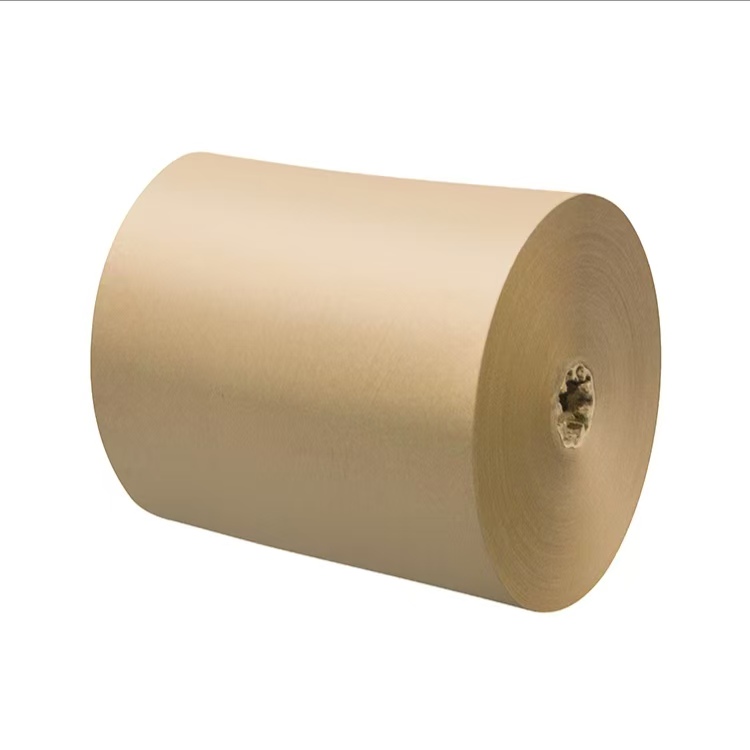
Core Technical Specifications of Kraft Paper Rolls for High-Speed Packaging
Tensile Strength, Runnability, and Sealing Efficiency in VFFS/HFFS Machines
In VFFS (Vertical Form Fill Seal) and HFFS (Horizontal Form Fill Seal) operations, kraft paper rolls must balance tensile strength with controlled elongation to withstand rapid acceleration, forming, and sealing. Bleached virgin kraft typically delivers a tensile index of 60–100 N·m/g (TAPPI T 2023), reducing web breaks during instantaneous acceleration from rest to full line speed. Runnability depends on uniform caliper, stable moisture content (ideally 5–7%), and clean, non-telescoping reel edges—features that ensure smooth passage through forming collars, ploughs, and sealing jaws. Virgin kraft grades offer more consistent tensile performance than recycled alternatives, minimizing splice-related stops on high-speed lines. Elongation of 1.5–3% in the machine direction absorbs tension spikes without compromising print registration or seal alignment. Sealing efficiency hinges on porosity and residual moisture: excessive moisture generates steam at heat-seal jaws and weakens bonds, while insufficient moisture increases brittleness and cracking risk. Converters commonly select 60–120 GSM natural kraft for pillow pouches and sachets, while 150+ GSM grades support gusseted and stand-up pouches. This precise interplay of tensile strength, dimensional stability, and moisture-responsive seal compatibility determines whether packaging lines achieve rated output without unplanned stops or registration drift.

Critical Physical Metrics: GSM, Burst, Tear, and Elongation for Industrial Reliability
Packaging engineers evaluate four core physical metrics when qualifying kraft paper rolls for automated lines. GSM (grams per square meter) governs stiffness and basis weight: light wrapping grades (40–70 GSM) suit void fill; mid-weight grades (70–250 GSM) serve bag applications; and heavy-duty grades (250–400 GSM) form folding cartons and industrial liners. Burst factor—measured as burst strength divided by basis weight—is a more reliable predictor of bag integrity than GSM alone, reflecting resistance to internal pressure before rupture. Tear resistance in both machine and cross directions prevents small nicks from propagating into catastrophic web breaks during abrupt tension shifts. Elongation must remain low enough to preserve print registration yet sufficient to absorb mechanical shock at forming jaws.
| Metric | Typical Range / Role |
|---|---|
| GSM | 40–400 across wrap, bag, and carton grades |
| Burst factor | Higher values signal better pressure resistance |
| Tear resistance | Maintains web integrity under tension spikes |
| Elongation | 1.5–3% MD absorbs shock without drift |
A stable roll requires tight tolerance across all four metrics; inconsistency in any one can trigger registration errors, sealing defects, or unscheduled reel changes—eroding line productivity and increasing operational cost.
Operational Advantages of Kraft Paper Rolls in E-Commerce Fulfillment
Seamless Integration into Automated Packing Lines: Real-World Deployment Insights
Kraft paper rolls integrate directly with automated packing equipment in modern e-commerce fulfillment centers. Roll-fed dispensers cut material to length on demand, supporting inline wrapping, void fill, and protective layering without manual sheet handling. This configuration reduces changeover time and sustains stable line speeds. A single roll can support hundreds of orders before reloading, and consistent web tension minimizes wrinkles, jams, and misfeeds—common failure points in high-volume operations. As many facilities adopt paper-first packaging mandates, shifting away from foam and plastic, roll formats meet the need for machine-controlled reliability: they feed continuously, adapt dynamically to variable package dimensions, and interface effectively with sensors and tension controls on carton erectors and wrap stations. Real-world deployments confirm smoother material flow and fewer manual interventions—especially in operations with high order volume and mixed SKU profiles—resulting in higher throughput and improved labor utilization.
Roll vs. Sheet: Just-in-Time Efficiency, Waste Reduction, and Line Uptime Gains
Roll-fed kraft paper enables true just-in-time dispensing—cutting only the length required per package—eliminating the overestimation, trim waste, and partial-sheet leftovers inherent in pre-cut sheet systems. Rolls store compactly, reduce floor space for replenishment, and require far fewer reloads: one roll often replaces dozens of sheets. Fewer reloads mean less downtime and greater line uptime—critical in busy fulfillment centers. Continuous feeding also eliminates handling errors tied to manual counting and sheet alignment. With multiple widths available at a single station, operators achieve rapid changeovers between package sizes. These advantages are especially impactful in e-commerce environments where order profiles shift throughout the day—delivering lower material waste, faster packaging cycles, and more predictable workflows.
Supply Chain Resilience Enabled by Kraft Paper Roll Performance
Kraft paper roll performance strengthens packaging supply chains through standardized formats, mechanical consistency, and multi-source availability. Unlike specialized polymer films constrained by volatile resin supply chains, kraft paper benefits from a mature global manufacturing base and widely distributed raw material sourcing—including North American, European, and Southeast Asian pulp mills. This allows packaging operations to qualify roll stock across multiple regions without extensive line reconfiguration, significantly reducing exposure to single-supplier disruptions. Industry analyses in 2024 confirm stable global capacity and resilient distribution networks for kraft paper, supporting reliable replenishment cycles.
In high-throughput fulfillment and industrial shipping, roll-level consistency in basis weight—commonly 60# to 90# (≈90–135 GSM) for heavy-duty applications—preserves runnability on automated equipment. Predictable tensile strength, tear resistance, and elongation reduce the probability of web breaks or jams—the leading cause of unplanned downtime. Heavy-duty kraft rolls also serve as interleaving, tier sheets, and surface masking in automotive, CNC, and appliance packaging, where consistent cushioning lowers product damage and returns during transit. Given that supply chain disruptions can erase up to 45% of one year’s profits over a decade (McKinsey & Company, 2020), reducing material-related stoppages is a direct operational hedge.
From an inventory standpoint, kraft paper rolls offer long shelf stability without the brittleness or moisture sensitivity of many plastic alternatives. Warehouses can hold safety stock without accelerated degradation, enabling just-in-time deployment while buffering against supplier delays or freight volatility. Key resilience factors associated with roll-format kraft paper include:
| Resilience Factor | Kraft Paper Roll Contribution |
|---|---|
| Sourcing flexibility | Mature global capacity and multi-region raw material base |
| Material consistency | Standard 60#–90# basis weights minimize changeover variability |
| Mechanical durability | Controlled tear, burst, and tensile strength reduce web breaks |
| Storage stability | Low sensitivity to humidity and temperature fluctuations |
| Regulatory readiness | Paper-based format aligns with single-use plastic reduction trends |
This combination of format predictability, mechanical performance, and storage tolerance makes the kraft paper roll a resilient packaging input for networks facing demand volatility, supplier delays, or sudden regulatory shifts.
Sustainability Impact: How Kraft Paper Rolls Support Circular Supply Chain Goals
FSC Certification, Biodegradability, and Closed-Loop Recyclability in Practice
Uncoated kraft paper rolls sourced with Forest Stewardship Council (FSC) certification connect high-volume packaging to verifiable responsible forestry. FSC chain-of-custody documentation enables procurement teams to confirm fiber originates from certified forests or controlled recycled sources. Because these rolls are typically single-material structures—free of laminates, metallization, or complex barrier coatings—they avoid the contamination and separation challenges that hinder recovery of multi-layer films. This matters: EU paper and cardboard packaging recycling exceeds 80% (Eurostat, 2023), meaning paper-only packaging flows efficiently through established collection and reprocessing infrastructure. In closed-loop systems, recovered fibers re-enter the mill as furnish, reducing virgin pulp demand and enabling multiple reuse cycles before fiber degradation limits further processing. Untreated kraft paper also biodegrades rapidly in commercial composting conditions—far faster than plastic films—and is accepted in many municipal organics programs. For supply chain teams, this translates to simpler waste audits, stronger ESG reporting, and seamless alignment with retailer paper-first mandates. A 2024 industry analysis found paper-only structures significantly improve recycling efficiency compared with mixed-material alternatives, making the kraft paper roll a practical lever for circular supply chain goals.
FAQ
What are the key factors for selecting kraft paper rolls for packaging applications?
Key factors include tensile strength, GSM (grams per square meter), burst and tear resistance, elongation, and moisture content. These properties collectively ensure mechanical durability, sealing efficiency, and runnability on automated packaging lines.
How do kraft paper rolls benefit e-commerce packaging operations?
Kraft paper rolls integrate seamlessly with automated packing lines, reducing downtime and material waste. Their roll-fed format supports just-in-time dispensing, minimizes jams, and adapts dynamically to varying package sizes for improved throughput.
Are kraft paper rolls sustainable?
Yes, kraft paper rolls are highly sustainable due to their biodegradability, recyclability, and compliance with FSC certification. They enable circular supply chain practices and align with global mandates like single-use plastic reduction.
What makes kraft paper rolls resilient in supply chain applications?
Resilience factors include sourcing flexibility, standardized mechanical properties (tensile strength, tear resistance, etc.), storage stability, and compatibility with automated equipment, reducing susceptibility to downtime and supplier disruptions.
Can kraft paper rolls be reused or recycled effectively?
Yes, kraft paper rolls are single-material structures, which simplifies recycling. They also support closed-loop systems where recovered fibers re-enter manufacturing cycles.
Table of Contents
- Core Technical Specifications of Kraft Paper Rolls for High-Speed Packaging
- Operational Advantages of Kraft Paper Rolls in E-Commerce Fulfillment
- Supply Chain Resilience Enabled by Kraft Paper Roll Performance
- Sustainability Impact: How Kraft Paper Rolls Support Circular Supply Chain Goals
-
FAQ
- What are the key factors for selecting kraft paper rolls for packaging applications?
- How do kraft paper rolls benefit e-commerce packaging operations?
- Are kraft paper rolls sustainable?
- What makes kraft paper rolls resilient in supply chain applications?
- Can kraft paper rolls be reused or recycled effectively?