


The Tension Between Freshness and Fibre
A fresh food pack is asked to do two things that sit awkwardly together. It has to hold a modified atmosphere long enough to protect the product, and it has to be recyclable in the systems that exist. MAP Series paper formats attempt both, and whether they succeed depends on which layer is being discussed.
The barrier is a film. Gas retention requires a continuous polymer layer with low oxygen transmission, and the more continuous the layer, the better it performs. Fibre is the opposite: porous, absorbent and structurally useful, but unable to hold a gas atmosphere alone. Any paper MAP pack is therefore a composite by definition, and packaging recyclability begins with admitting it.
That does not make it a compromise. It narrows the design question: how cleanly can the two materials be separated, and does that separation happen in a real waste stream rather than a laboratory? MAP Series formats are built around a film that splits from the paper base, which answers half of that question by design.
The sections below work through the material logic, the separation step, the evidence behind a claim and the questions to ask before printing.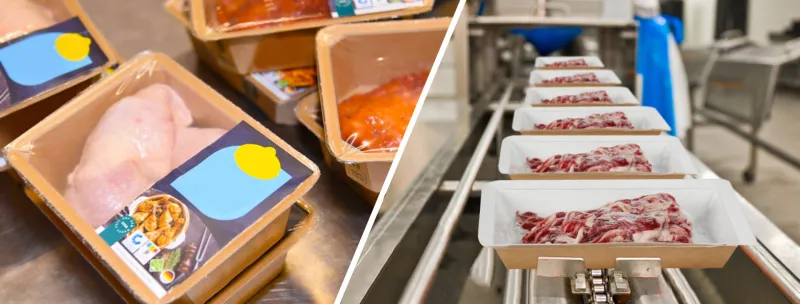
Why a Barrier and a Fibre Pack Pull in Opposite Directions
In a MAP Series format, two materials with opposite jobs have to occupy the same few millimetres of pack. Understanding which job each one performs makes the recycling conversation concrete rather than rhetorical.
The Function the Film Has to Perform
A modified atmosphere survives only if the package walls resist gas transfer for the whole shelf life. That is a film property rather than a fibre property, so the MAP Series uses a high barrier EVOH layer to keep oxygen out and the chosen atmosphere in. The layer is thin because barrier performance comes from continuity rather than from thickness, but thin layers are also the hardest to remove at a recycling plant. Every gain in barrier performance has to be weighed against the difficulty it creates downstream.
What the Fibre Side Can and Cannot Do
In the MAP Series, paper brings rigidity, printability and a surface that consumers already read as lower-plastic. It also brings a structure that holds shape on a sealing machine and stacks on a pallet, which a film alone cannot do. What it cannot do is hold pressure, so the atmosphere depends entirely on the film and the seal. Paper based food packaging works when the fibre is treated as the structure and the film as the function, not when the fibre is credited with barrier performance it does not have.
How Paper and Film Are Separated in Practice
The recycling story of a MAP Series pack is decided in two places: at the design desk, where the layers are chosen, and at the mill, where they are pulled apart. Both have to work for the claim to survive contact with a customer.
Design Choices That Keep the Split Clean
The MAP paper bowl and the rectangular formats in the range are built so that the film can be split from the paper base once the pack is empty. That sounds like a small detail and it is the most important one, because a consumer who cannot separate the layers will not try twice. Design decisions that matter in paper based food packaging include a film that lifts from a defined edge, a paper surface that does not tear with it, and a food-contact coating that does not bond the two together permanently.
What Happens at the Sorting and Repulping Stage
Once collected, a MAP Series pack enters a stream where the mill decides its fate. Fibre recovery depends on the film releasing in the pulper rather than wrapping around the rotor, and on the coating dispersing rather than forming flakes. A pack that separates easily in the hand usually separates easily in the pulper, but the two are not the same test and only one of them is measurable. Buyers should ask for evidence from a repulping trial rather than an assurance that the design is separable in principle.
What a Recyclability Claim Actually Requires
For a MAP Series pack, claims are where good design and good marketing drift apart. A statement printed on a pack is a promise made to a customer who will never test it, which is why it deserves the same rigour as a dimensional specification.
Evidence Behind the Statement
A defensible claim names the stream, the geography and the component. Recyclable in which collection system, for which component, and under what conditions? For a MAP Series pack the relevant evidence is a mill trial showing fibre recovery and a film that releases cleanly, plus a check that the local stream accepts the format at all in that region. Certification of the paper itself is a separate matter from packaging recyclability, which is a property of the assembled pack, and conflating the two is the most common error in sustainable food packaging communication.
Language That Outruns the Evidence
Words such as fully recyclable, plastic free and compostable appear on packs far more often than the supporting data justifies. A composite pack with a polymer barrier is not plastic free, and a paper pack with a film lid is not mono-material. The safer pattern is to state what the consumer should do, describe the separation step in one line, and avoid implying that the whole pack enters a single stream. Precision here protects the brand from a complaint it cannot answer, and sustainable food packaging claims age badly when they outrun the design.
Specification Questions That Keep the Claim Honest
A buyer who asks the MAP Series supplier the right questions before approving artwork rarely has to withdraw a claim afterwards. The questions are technical, and the answers should be documentary rather than verbal.
Questions for the Converter
Ask which film grade is used in the MAP Series format, how it is bonded to the paper, and what the intended separation method is for the person holding the empty MAP paper bowl. Ask whether the coating is water-based or a polymer laminate, because that single choice changes what the mill can actually recover. Ask for repulping evidence and the format it was tested in, since a trial on one bowl does not cover a tray with a different geometry. Then ask what changes on the line if the barrier requirement tightens.
Questions for the Customer and the Waste Stream
The second set of questions belongs to the retailer and the waste authority. Does the local collection accept paper food packaging with food residue, and does the mill in that region want the fibre? A pack that recycles well in one market can be landfilled in another for reasons that have nothing to do with its design. Building the claim around the markets actually served, rather than around the best case, is the difference between a statement the brand can defend and one it has to edit later.
FAQ
Is MAP Series paper packaging actually recyclable?
It is designed to be separable, which is the condition that makes fibre recycling possible rather than a guarantee that it happens. The film splits from the paper base so the two can enter their own streams, and the paper side is then a candidate for normal fibre recovery. Whether that occurs depends on the collection system, the mill and the consumer. A supplier should be able to show repulping evidence, and the brand should describe the separation step on the pack.
Does a paper MAP pack keep food as fresh as a plastic one?
Freshness comes from the atmosphere and the barrier, not from the base material, so a paper format with a high barrier film can deliver a comparable result. The MAP Series uses an EVOH barrier layer and accepts standard MAP sealing films and equipment, which is the same functional approach a plastic tray uses. What differs is the physical protection and the sealing window, both of which need to be tested on the actual product rather than assumed.
What should appear on the pack about recycling?
State the action, not the ambition, and keep it short enough to read on a MAP Series bowl. A short line telling the customer to separate the film from the bowl, plus the local collection guidance that applies in the market where the pack is sold, does more than a symbol. Avoid absolute words unless the evidence covers the whole pack in every market served. The test is simple: could the brand defend the sentence to a regulator with documents rather than intent.