


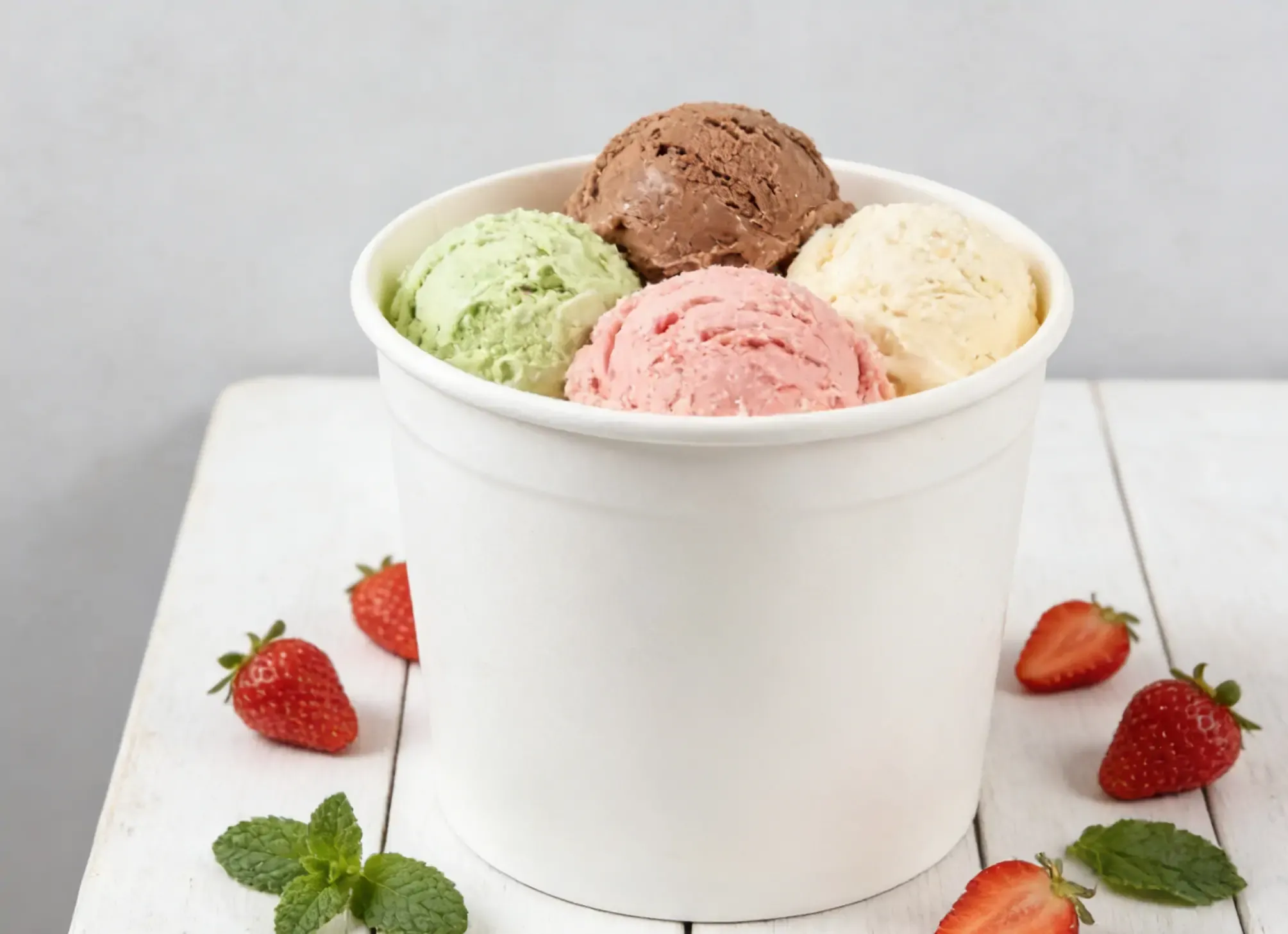
Where Frozen Dessert Packaging Actually Fails
An ice cream cup rarely fails on the day it is filled. It fails in a display freezer three weeks later, when the seam has drawn water and the paper has lost the stiffness that held the stack. It fails again at the counter, when a server lifts an ice cream cup and the rim folds because the board absorbed moisture during a defrost cycle. None of these events look like a packaging defect at the moment they happen.
The common thread is that frozen dessert packaging is asked to do two contradictory jobs. It must resist water in an environment defined by condensation, and it must resist fat from a product that is roughly a tenth to a sixth fat by weight. Paper does neither on its own. Every ice cream cup on the market is a paper structure plus a barrier, and the barrier is where brands win or lose.
Moisture and grease also fail differently, which is why a single fix rarely covers both. Water attacks the fibre network and shows up as loss of strength, wicking at exposed edges and seam separation. Fat attacks the surface and slowly travels through the sheet, showing up first as a translucent patch and later as a stained outer wall that reaches the customer's hand.
This article takes the two failure modes separately, then brings them back together in the barrier selection, the test protocol and the purchase specification. The assumption throughout is that the buyer is a brand owner or a co-packer who has already seen a complaint and wants to know which variable to change.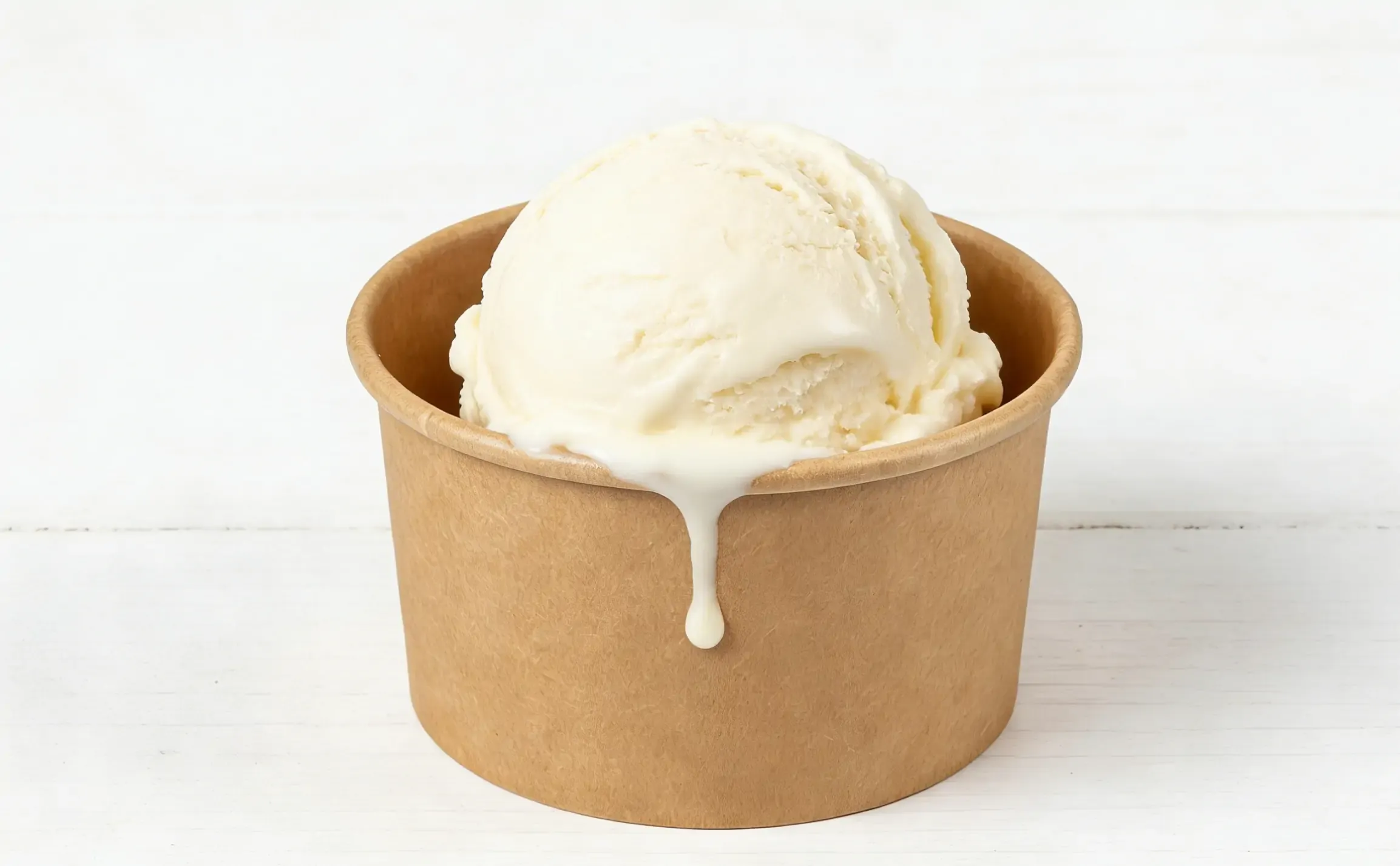
How Moisture Attacks an Ice Cream Cup
Water reaches frozen dessert packaging from three directions: condensation on the outside, moisture from the product on the inside, and humidity in storage between production and filling. Each one attacks a different part of the structure.
Condensation Inside the Freezer and on the Way Out
A freezer holds very little water vapour, but the air around it does not. Every time a case is opened, or a pallet moves from a cold store to a warm loading bay, the surface of the cup crosses a dew point and water condenses on it. That film of water sits on the outer wall, the rim and the base, and it is absorbed by any exposed fibre.
The damage is cumulative rather than instant. One condensation cycle softens the surface of an ice cream cup. Repeated cycles let water reach the seam and the raw edge of the bottom disc, and that is where structural strength goes first. Brands that run a cold chain with several handover points should expect more condensation exposure than a brand that fills and freezes in one building, and the specification should reflect that difference rather than assuming one ice cream cup suits both.
Wicking at the Side Seam and the Bottom Disc
The side seam is the part of an ice cream cup where the board overlaps itself, and it is the hardest place to protect. Coating on an ice cream cup covers the flat surfaces, but the cut edge of the overlap is a direct route into the fibre. Water that enters there travels along the seam by capillary action and separates the bond from the inside out.
The bottom disc of an ice cream cup has the same weakness in a different geometry. Its edge is crimped into the wall, and any gap in the coating at the crimp becomes a wicking path. This is why ice cream cup failures often appear as a ring of softness at the base rather than a visible hole. A buyer inspecting a complaint should cut a failed cup open and look at the seam and the disc edge before accepting any explanation about board grade, because the fault is usually in how those two joints were sealed rather than in the paper itself.
Rim Softening and Stack Collapse
The rim of an ice cream cup carries the load in a nested stack, and it is the thinnest, most exposed part of the structure. Moisture softens the rim, the curl loses its memory, and cups that were nested at the factory begin to jam or, in the other direction, to seat too deeply and split. Both outcomes stop a filling line.
Rim softening also breaks lid fit, which matters more for an ice cream cup than for a beverage cup because frozen desserts are often lidded and stacked in a display case where the lid is the only thing holding the top closed. A rim on an ice cream cup that has absorbed water will not hold a lid under load, and the failure appears as a popped lid in a customer's bag rather than as a packaging defect on the line.
How Fat Moves Through Paper
Grease failure is slower and less visible than water damage, which is why it often escapes incoming inspection and reaches the consumer. Fat does not dissolve paper, but it wets the fibres and travels through the sheet along the same capillaries that carry water.
Grease Bleed and the Translucent Spot
The first sign is a change in appearance. A patch of the outer wall turns slightly darker or more translucent as fat fills the air gaps between fibres. On an uncoated or lightly coated ice cream cup, that patch appears within hours at warm ambient temperatures and within days in a freezer case. Once fat reaches the outer surface, the ice cream cup feels slick and picks up dust, and print begins to look muddy.
Grease resistance is not a single property but a threshold that depends on temperature and time. A coating that holds for an hour at chilled temperature may fail after a day at room temperature, and the failure will look intermittent to a quality team that samples only straight from the freezer. Brands that distribute through retail, where the cup may sit in a shopping bag for an hour, need a barrier tested at that condition rather than at the filling line.
Where Gelato and Frozen Yogurt Differ From Standard Ice Cream
Not every frozen dessert loads the barrier equally. Gelato is churned with less air and served warmer than hard-pack ice cream, so the gelato cup sees a denser product at a temperature where fat is more mobile. The result is a higher grease load per unit of surface area, and a specification copied from a standard ice cream programme may be marginal.
Frozen yogurt sits at the other end. It usually carries less fat but more acidity, and it is often served soft, which means the product is in contact with the wall for a short time at a relatively warm temperature. The dominant risk shifts from grease to moisture and acid attack at the seam. A brand running all three products should expect to specify more than one ice cream cup, and the gelato cup in the range will usually carry the highest grease load rather than assume that the most demanding one covers the range.
Acidity and Colour in the Frozen Yogurt Cup
Fruit-based frozen yogurt introduces organic acids that attack both the coating and the ink, which is why a frozen yogurt cup designed for a plain base often underperforms once a fruit line is added. Acid attack is slower than water damage but it is persistent, and it shows up as delamination at the coating-to-board interface or as colour shift in the printed area. Heavily pigmented inks are more vulnerable, and the effect is easy to miss because it develops over a shelf life.
Colour is also a quality signal in its own right. A frozen yogurt cup that bleeds colour at the rim looks unhygienic even when the product is fine, and the cause is usually a water-based ink printed too close to an unprotected edge. Brands should confirm that the ice cream cup coating covers the printed panel and the cut edge, and should test a filled cup at shelf-life conditions rather than judging print quality from a flat sheet.
Barrier Choices and What Each One Buys
Barrier selection for an ice cream paper cup is a trade between protection, cost, recyclability and print quality. No single coating wins on all four, and the right answer depends on which failure mode dominates the product.
Polyethylene Coating and Double Coating
Low-density polyethylene remains the default barrier for ice cream cup board because it resists both water and fat and survives folding and crimping without cracking. A standard single coating handles most ice cream cup applications, and a double coating is used where the product is wetter, the seam is under more stress, or the cup is handled roughly in distribution.
The drawbacks are familiar. PE-coated board is harder to repulp in standard mills, which matters in markets with strict packaging waste rules, and the coating limits heat resistance if the cup is ever used for a warm product. Buyers choosing a polyethylene-coated ice cream cup should also confirm that the coating extends across the bottom disc and the seam overlap, since a barrier that stops at the flat surfaces leaves the two weakest joints unprotected.
Aqueous Coatings and the Grease-Resistant Paper Cup
Water-based dispersion coatings offer grease resistance without a plastic film, and they are the usual route to a grease-resistant paper cup that can be marketed as plastic-free. They perform well against fat and reasonably against short-term moisture, and they print cleanly because the coating sits on the surface rather than forming a separate film.
The limitation is water resistance over time. An aqueous coating is not equivalent to PE in a wet environment, and a brand that specifies it for a product with high free water, or for a cold chain with heavy condensation, may find the seam softening earlier than expected. Coating continuity matters more than coat weight here. The practical approach is to specify an ice cream paper cup with aqueous coating where the grease load is the main risk, and to keep a PE or PET option for the wettest products in the range.
PET-Coated Board and PLA Under Cold Service
PET-coated board brings a heat-resistant barrier and strong grease hold to an ice cream cup, and it is the natural choice where a cup might be used across frozen and ambient or warmed applications. It costs more than PE and carries its own repulpability questions, but it solves the dual-temperature problem that a single-product brand rarely faces and a multi-product brand often does.
PLA coatings answer the compostability requirement and perform acceptably in cold service, but they are sensitive to temperature and become brittle at deep-freeze conditions if the grade is not chosen carefully. A brand specifying a compostable ice cream cup should test the coating at the lowest temperature in its chain and at the highest humidity in its storage, because those two conditions together are where bio-based barriers are least forgiving.
Tests That Reproduce Failure Before It Reaches the Freezer
Most ice cream cup complaints could have been predicted with a week of bench work. The tests below are not exotic, and they can be run on samples before a season's volume is committed.
Cobb, Kit and Barrier Values Explained
Three numbers cover most of the barrier question. Water absorptiveness is measured by a Cobb test, which reports how many grams of water a square metre of board takes up in a fixed time; a lower value indicates a better water hold. Grease resistance is measured by a kit test, which rates the sheet on a scale where higher numbers mean resistance to more aggressive fatty solutions. Water vapour transmission rate completes the picture for long storage.
The numbers only mean something when paired with a use condition. A kit rating that looks strong on a flat sheet can collapse at a folded seam, so buyers should ask for values measured on formed cups rather than on the parent board, and should ask at what temperature and contact time the test was run.
Freeze-Thaw Cycling and Compression Load
A freeze-thaw cycle is the closest bench approximation of a real cold chain. Fill the ice cream cup, freeze it, bring it to room temperature, refreeze it, and repeat five times, then inspect the seam, the bottom crimp and the print. Delamination, whitening or a soft base after five cycles is a warning that the barrier is not continuous.
Compression testing follows the same logic. Stack the ice cream cups to the height used in the freezer or the pallet, load them as the distribution plan requires, and measure deflection after the cycle rather than before it. An ice cream cup that holds a stack when dry and warm will often fail when cold and damp, and the failure appears as a lean in the pallet rather than a crack in a single unit.
Print, Adhesion and Scuffing Under Condensation
Print failures are the ones customers photograph. Condensation softens the surface, and abrasion between nested cups then lifts ink at the rim. Rub the printed area with a damp thumb after a condensation cycle, and compare the result with the same test on a dry ice cream cup; a difference in ink removal points to insufficient coating coverage or an ink system that is not designed for a wet surface.
Adhesion matters for the same reason. Where a label or a lid film is applied, moisture at the interface will defeat an adhesive that performs perfectly in a dry room. Brands running applicator lines should test adhesion at freezer temperature and again after a thaw, because adhesives that grip at 20°C are not automatically suitable at -18°C.
Writing a Specification That Holds Across a Product Range
A specification is only useful if it survives a supplier change, a product launch and a seasonal volume swing. That requires fixing the variables that cause failure and leaving the rest to the supplier.
Fields to Fix in the Purchase Order
The essential fields are board grade and grammage, coating type and coat weight, whether the coating covers the seam and the bottom disc, the seam bonding method, the ice cream cup dimensions with tolerances, the intended service temperature, and the required barrier values with the test conditions. Add the packing format, because ice cream cups supplied loose behave differently on a filling line from cups supplied in sleeves.
Two further fields are often omitted and later cause disputes. The first is the acceptable colour tolerance for the printed area, since a barrier change can shift ink laydown. The second is the maximum storage humidity before filling, because a carton that absorbs moisture in a warehouse arrives at the line with a barrier that is already compromised. Writing both into the order gives the brand a defensible position when a batch underperforms.
Carton, Pallet and Freezer Storage Discipline
Storage is part of the barrier for an ice cream cup. Cartons left on a damp floor or against an outside wall absorb moisture through the board, and the ice cream cup inside inherits that moisture before it is ever filled. Keep cartons on pallets, away from walls, and rotate stock so that older material is consumed first rather than held through a humid season.
Pallet configuration deserves the same attention. A stack that is stable in a dry warehouse can lean in a freezer as the board takes up water and the compression strength drops. Brands should confirm the stack height the supplier designed for, keep the original pallet pattern, and avoid re-stacking cartons into taller loads to save floor space, since that decision quietly spends the safety margin built into the specification.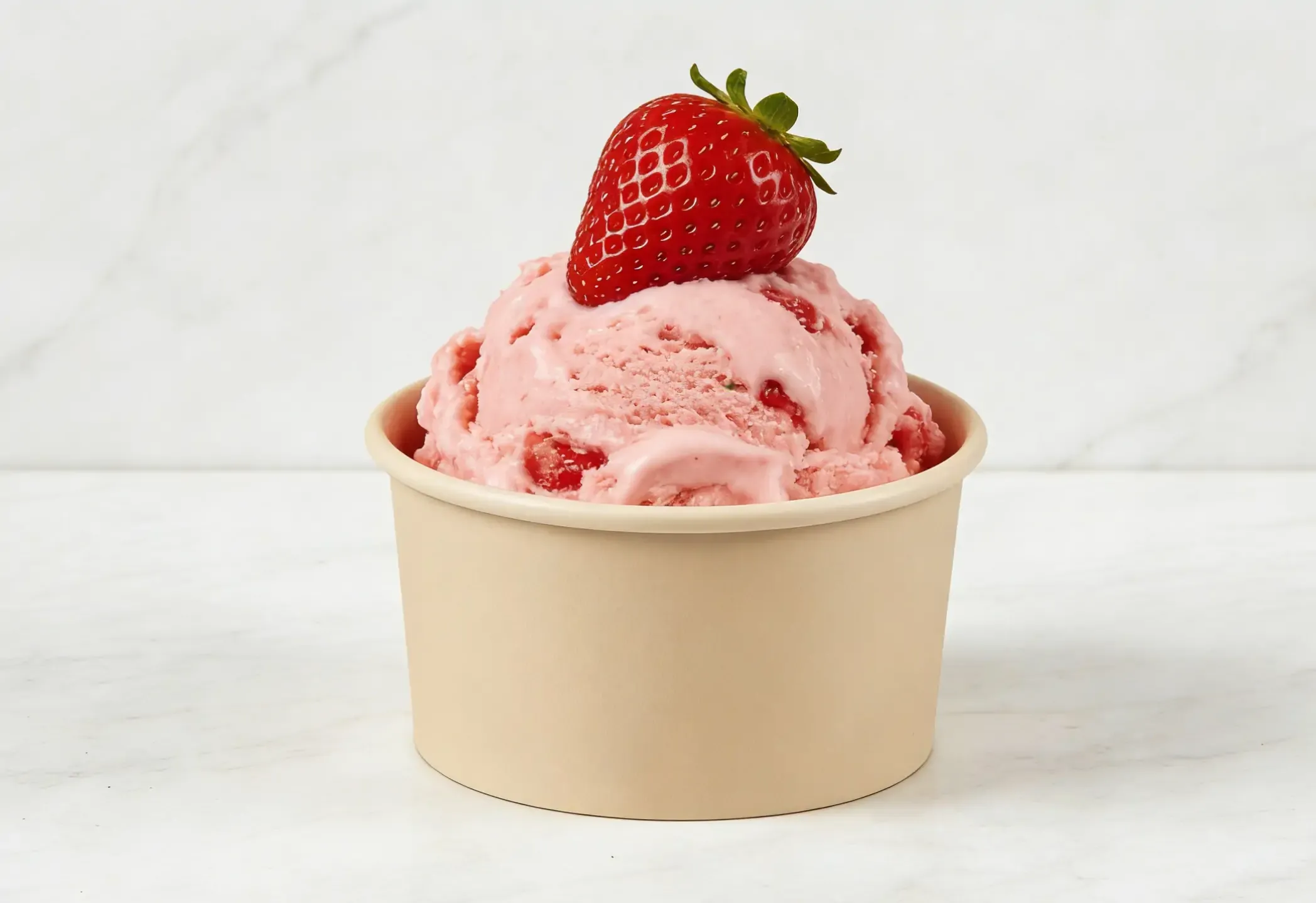
FAQ
Why does an ice cream cup fail in the freezer but pass inspection at goods-in?
Incoming inspection usually tests a dry ice cream cup at room temperature, which is the condition where paper is strongest. Failure appears after moisture has been absorbed and after the cup has been through several temperature transitions. An ice cream cup that passes a dimensional check can still have a discontinuous coating at the seam or the bottom crimp, and those gaps only open once water has softened the fibre around them. Testing formed ice cream cups after a freeze-thaw cycle closes most of that gap. If a batch fails that test, the first place to look is coating continuity at the seam and the bottom crimp, not the board grade.
Is a grease-resistant paper cup suitable for gelato and frozen yogurt?
It depends on which barrier the coating provides rather than on the marketing term. Grease resistance addresses fat migration, which is the dominant risk for gelato because it is dense and served warmer. Frozen yogurt brings acidity and moisture, which stress the seam and the coating interface instead. A brand selling both should confirm the coating's performance against acid and water, not only against fat, and should test each product separately on the same ice cream cup format. Where a single format must serve the whole range, choose the barrier that satisfies the most demanding product and accept the extra cost across the line.
Does a heavier board solve moisture and grease problems?
Only partly. Grammage adds stiffness and gives water more fibre to travel through before reaching the outer surface, but it does not stop fat migration and it does not seal a cut edge. A heavier board with a discontinuous coating will still wick at the seam, and the extra material raises cost and freight without addressing the cause. Barrier continuity matters more than thickness, which is why a moderate board with full coating coverage usually outperforms a heavy board with a partial one. If complaints persist after a grammage increase, the barrier is the variable to change.
What should a brand ask for when approving a new ice cream cup supplier?
Ask for barrier values measured on a formed ice cream paper cup with the test conditions stated, samples that have been through a freeze-thaw cycle, a written statement of which surfaces are coated, and a production-batch printed sample rather than a hand-made mock-up. Confirm the seam bonding method and the storage limits before filling. A supplier that answers these questions in documents is easier to hold to a specification than one that answers them in conversation. Keep those documents with the purchase order, so that a batch dispute is settled against a written baseline rather than a memory of a sample.